What Is AI Contract Review? A Complete Guide


AI contract review is software that reads a contract, compares it against a standard, and tells you where the two don't match, with suggested wording to fix it. The standard can be your own playbook or a general one. A person then decides what to do with each issue it raises.
What happens when you run a review
Under the hood, the steps are fairly consistent across tools.
First, the software takes in the file. Word documents and PDFs go straight in. Scanned pages go through optical character recognition (OCR), which turns an image of text into text the software can read.
Next it pulls out the basics: the parties, the contract type, the governing law, and dates like the start date, end date and notice to terminate. This part is useful on its own, because it is the information that gets lost once a signed PDF goes into a folder.
Then it splits the contract into clauses. This sounds trivial and isn't. Clause boundaries in real contracts are messy, with definitions buried in one section changing what another section means.
Then comes the comparison. Each clause is checked against the standard you gave it. With a playbook, that means your positions: what you want, what you would accept as a fallback, and what you never accept. Without one, the tool falls back on general drafting norms, which is useful but knows nothing about your business.
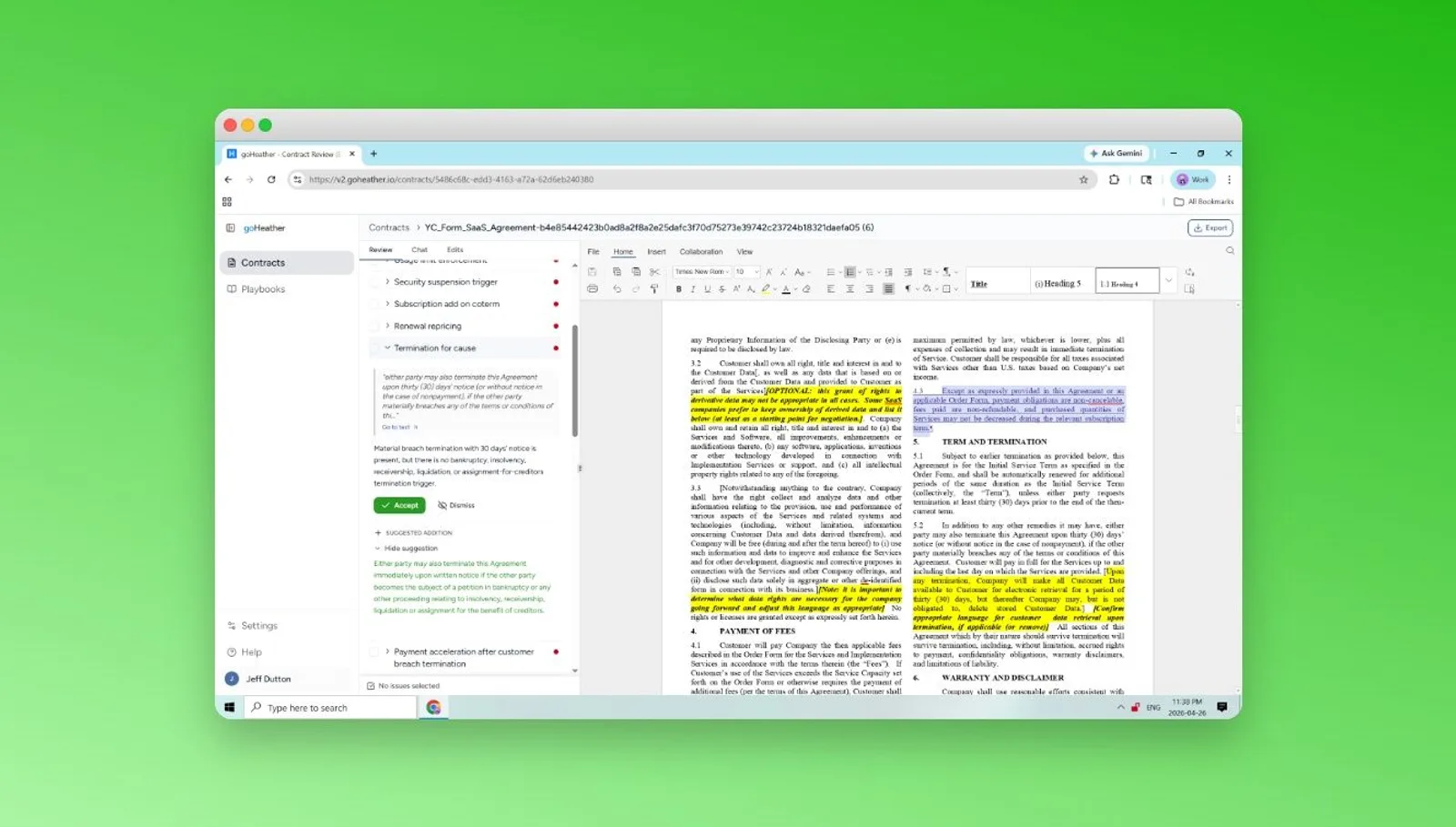
Finally it produces findings. A good finding names the problem, points to the exact clause, explains in plain words why it matters, and offers replacement language. Older contract software mostly searched for keywords and highlighted every clause that contained them. The current generation, built on large language models, reads the clause in context and writes the fix.
Sample clause: limitation of liability
Here is what that looks like in practice. The clause below is made up for illustration, and the redline shows the kind of output a review returns. It is not a recommended position, and the right numbers for your contracts are a commercial and legal call for your team.
Say you are the customer, and this is section 12 of a vendor's software agreement:
12.1 Except for Customer's payment obligations, neither party's aggregate liability arising out of this Agreement shall exceed the fees paid by Customer in the one (1) month preceding the claim.
12.2 Vendor shall have no liability for any loss of or damage to Customer Data, however caused.
In goHeather, a review run from the customer's side would raise a finding along these lines, ranked High:
Finding: Vendor carries no liability for losing your data.
Original clause: Section 12.2, quoted in full, with a jump to the text in the document.
Suggested redline:
12.1 Except for Customer's payment obligations, neither party's aggregate liability arising out of this Agreement shall exceed the fees paid or payable by Customer in the twelve (12) months preceding the claim.
12.2 Vendor's liability for loss of or damage to Customer Data caused by Vendor's breach of this Agreement shall be subject to a separate cap equal to [ ] times the fees paid or payable in the twelve (12) months preceding the claim.
In plain English: As written, 12.2 means the vendor owes you nothing if it loses your data, even through its own mistake, and 12.1 limits everything else to one month of fees. If this vendor holds data your business depends on, the contract leaves almost all of that loss with you. The redline brings data loss back inside the agreement under its own cap and widens the general cap, with the multiple left blank for you to set.
From there a person decides. You can apply the redline, edit it, dismiss the finding, or mark the term as unacceptable. If your playbook already has a rule on data loss caps, the review measures the clause against your rule instead of general drafting norms.
Where it helps
The payoff comes from volume and repetition. A few places where it tends to matter:
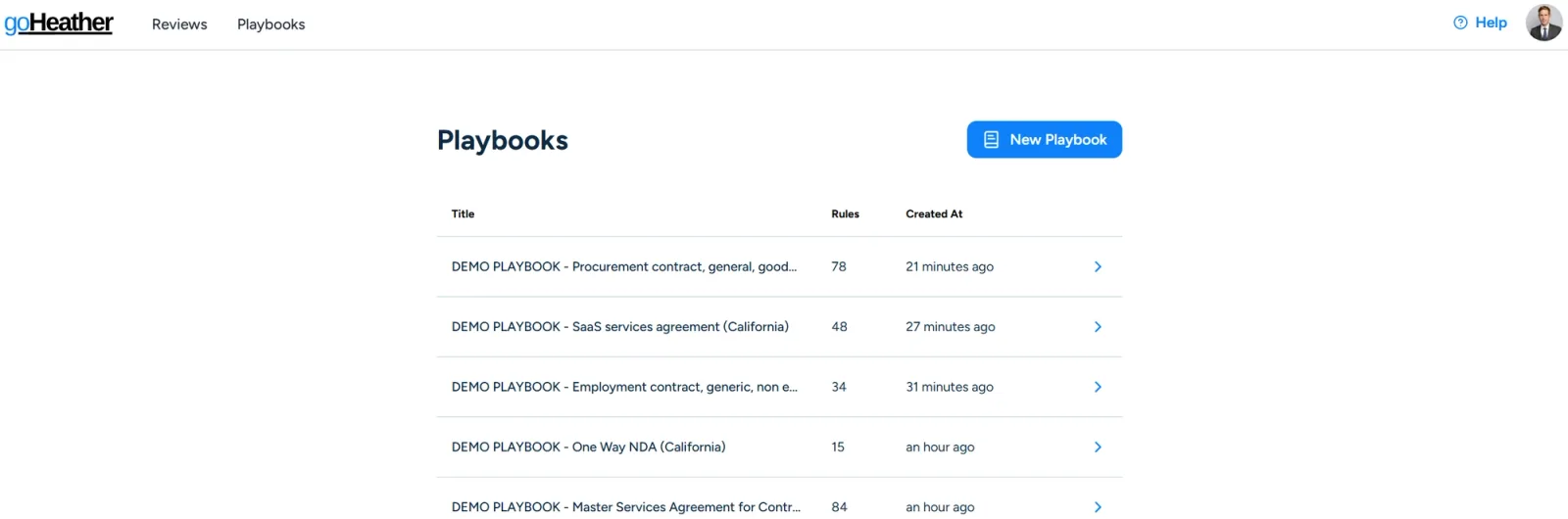
Inbound vendor and supplier paper. Procurement teams see the same issues over and over, in a different order and different wording each time. A first pass against the procurement playbook turns a full read into a check of the flagged items.
NDAs and routine agreements. These are where a playbook does the most work, because the positions are settled and the volume is high.
Software licenses and service agreements. These are where usage limits, data terms and renewal terms tend to sit in places nobody reads twice.
Amendments and related documents. Reviewing an amendment against the original, or a statement of work against the master agreement, is slow by hand and well suited to a tool that can read both. Documents that aren't uploaded aren't in the review, so feed in the exhibits and schedules too.
A stack before a deadline. In due diligence, the job is finding which contracts contain certain terms across hundreds of files. Software can sort that stack for human review much faster than a person reading front to back.
For law firms, the same review becomes the first step in a lawyer's usual process: a first pass from the client's side of the deal, which the lawyer then checks, edits and turns into advice. For business teams, it is how sales, procurement or finance can take a first pass on routine paper and send only the real exceptions to counsel.
Where a person still decides
AI contract review is a first pass. Every finding is a proposal, and the suggested redline is drafting language, not a position on what you should accept.
Language models can still state wrong things with confidence. Stanford HAI researchers who benchmarked AI legal research tools in 2024 reported that even tools built for lawyers gave wrong or unsupported answers in about one of every six queries or more. Contract review is a narrower job than open-ended legal research, since the text is right there to check, but the lesson holds: someone has to read the clause the finding points to.
That is also how NIST's AI Risk Management Framework frames it. It asks organizations to define and document how people oversee an AI system's output, rather than leaving that to chance. In contract review, the practical version is a workflow where nobody can close a review until each finding has been accepted or dismissed by a person, and where the record shows who decided what.
A few other limits worth knowing before you roll it out:
A review without a playbook is general. It will catch drafting problems and one-sided terms, but it does not know that your company never accepts unlimited indemnities or always wants 30 days' notice.
The software reads what you give it. A rate sheet or service guide that the contract refers to but nobody uploaded is invisible to it.
It takes minutes, not seconds, on a long agreement. Kick it off and come back.
How goHeather handles it
goHeather is built around the workflow above. Click "Review with AI" and it sets up the review itself: parties, your side, governing law and review depth, all shown as editable settings. Findings come back grouped High, Med and Low, each with the original clause, a suggested redline and a plain-English explanation, and the review counts how many findings are still waiting on a decision. When a finding reflects a call you will make again, "Add to playbook" turns it into a rule for every later contract.
You can see how it works on the AI contract review product page. If you are comparing vendors, our roundup of the best AI contract review tools for 2026 covers what each one is built for.
This is legal information, not legal advice; consult a lawyer for legal advice.
Review any Contract With AI Before you Sign it