MAJOR UPDATE
The New goHeather: In-app editor, surgical AI edits, edit from chat, and adjustable analysis levels.
Try For Free Now





A mid-sized financial services firm signs hundreds of IT vendor contracts a year. MSAs, SOWs, NDAs, DPAs, order forms, renewals. Most get reviewed under time pressure by analysts and procurement leads who aren't lawyers, and aren't going to wait two weeks for outside counsel to turn around a redline on a $40,000 SaaS subscription.
IT vendor contract AI review is the obvious lever. The question is which tool actually does the job, and what "doing the job" even means.
This is a working guide to what good IT vendor contract AI review looks like, where most tools fall short, and how goHeather is built for the people actually doing the work.
A meaningful IT vendor agreement is rarely one document. There's the MSA, the order form, the data processing addendum, an information security exhibit, a sub-processor list, and one or more SOWs. Each layer can override or contradict the one above it.
The clauses that actually matter (incident notification timelines, sub-processor flow-down, audit rights, data residency, indemnity carve-outs for security breaches) are scattered across those documents, often buried in exhibits, sometimes incorporated by reference to a URL the vendor controls.
A senior analyst can do maybe 15 to 20 substantive IT vendor reviews a month if they're also drafting redlines, sitting on negotiation calls, and answering procurement's daily questions. The math doesn't work at any FRFI managing hundreds or even thousands of vendor relationships.
That's the gap AI review is meant to close.
Three IT vendor contract AI review capabilities, often bundled but worth separating.
First, clause extraction and classification. The tool reads the MSA, the DPA, and the exhibits, and tells you what's in there. Liability cap, governing law, breach notification window, sub-processor terms, audit rights, data location commitments. This is table stakes.
Second, playbook comparison. Your company has positions. Liability cap at 2x annual fees with a super-cap for security incidents. Breach notification at 24 hours, not 30 days. Sub-processor changes with 30 days' notice and a right to object. AI review should compare the vendor's draft against your positions and flag every gap.
Third, suggested edits that you can actually apply. This is where most tools stop short. They flag the issue and walk away. A useful tool drafts the redline for you, in your firm's language, against your playbook, and lets you put it into the contract without leaving the app.
You've probably already tried this. Paste an MSA into ChatGPT, ask what to push back on, and the answer is genuinely good. Same with Claude and Gemini. The frontier models understand contracts. They can spot a one-sided indemnity, a weak breach notification window, or a missing audit right.
The problem isn't the analysis. It's what happens after.
You get a wall of text. Eight or ten or fifteen issues, each with a suggested edit. Now you open Word, find the clause, copy the suggested language, paste it in, fix the formatting, and move to the next one. Forty-five minutes later you're done with the apply step alone, and you still haven't sent the redline back to the vendor.
These models also don't know your playbook. ChatGPT will tell you a 2x liability cap is reasonable, but your firm's position might be 2x with a super-cap for security incidents. Generic best practice isn't your standard. Every suggestion still has to be mentally diffed against what your firm actually wants.
Here's the thing. goHeather runs on the same frontier models. Claude, GPT, Gemini. The intelligence is the same. What changes is everything around it.
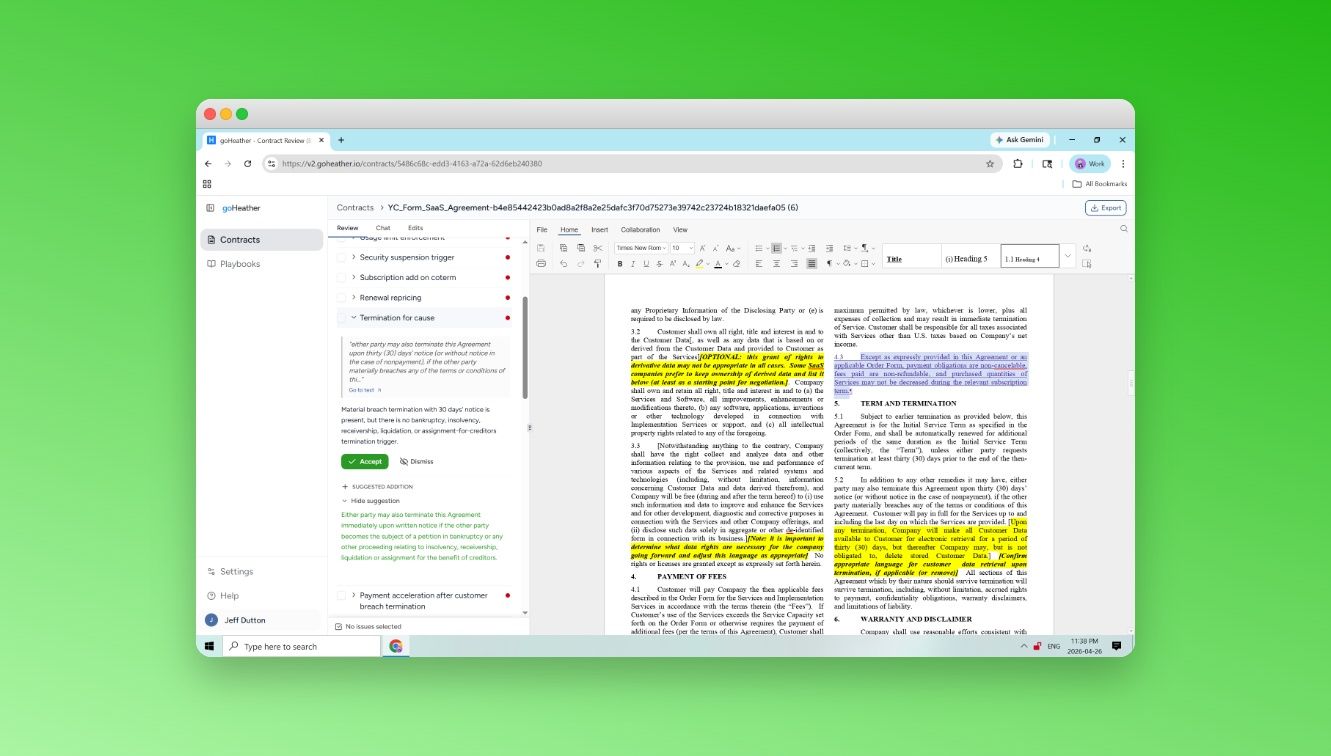
goHeather knows your playbook because you load it in once. It runs the analysis, lists the issues in a checklist beside the contract, and shows you a suggested edit for each one. You click apply. The edit lands in the document, in front of you, in the app. No copy-paste. No Word. No formatting cleanup.
goHeather is Claude, ChatGPT, and Gemini, wrapped in a purpose-built workflow for contract review. Step by step. Surgical edits. Applied right in the document.
If you don't agree with a suggestion, click to ignore it. If you want to tweak the language, edit it or even chat with it. If your playbook position is too aggressive for this particular vendor, override it. The tool does the drafting work. The analyst makes the calls.
The result is contract review time cut by more than half. Reviews that used to take two hours take forty-five minutes. Reviews that used to sit in a queue for a week clear in a day. Analysts spend their time on the calls and the exceptions, which is where the leverage actually is.
A vendor sends back a redline on the MSA. You upload it. goHeather flags eight issues against your playbook. The breach notification window stretched to 72 hours. The sub-processor list dropped. The cyber liability cap got rewritten as a sub-cap of the general cap.
You see the eight issues in a checklist. Each one shows the vendor's language, your playbook position, and a suggested edit. You agree with six, tweak one, skip one, and apply them all in under a minute. You send the redline back to the vendor.
That's the loop. Built for analysts who are running ten of these reviews a week.
A short evaluation list.
If a tool can't answer those well, among other questions regarding due-diligence, privacy and security, the analyst will still be doing most of the work manually. Just with extra steps.
IT vendor contract AI review isn't about replacing the analyst. The judgment calls still belong to a human who understands the firm's risk appetite. The win is removing the hours spent finding the right clause, diffing against the playbook, and drafting the same redline you've drafted thirty times before.
goHeather turns those hours into minutes. View the issues. View the suggestions. Apply the ones you agree with. That's the whole loop.
Book a demo or start a free trial to see how goHeather handles your next IT vendor contract.
Jeff Dutton is a lawyer who advises on technology, corporate, privacy, commercial, employment and real estate law.
Jeff founded his own small law firm, Dutton Law, in 2016 (and merged it with a larger firm in 2019). Before that, Jeff was a prosecutor and a commercial law lawyer at a national boutique law firm.
Jeffrey is a frequent lecturer on legal matters and has been published in newspapers and trade journals. In addition, Jeff was the editor and co-author of a leading employment law text for lawyers for many years.
Education:
Western University, BA (2009)
University of Ottawa, Faculty of Law, JD (2012)
Get the latest contract tips, updates, and exclusive content straight to your inbox. Subscribe now and never miss out on what's new in contract law or at goHeather!
Our AI sifts through each clause, identifying potential risks. This enables us to provide quick yet comprehensive contract reviews, equipping you with the legal information you need to make informed decisions.
goHeather enables you to quickly create local employment contracts using lawyer-made templates. Our contracts include a free e-signature feature and provide access to a dashboard for managing all your employee contracts and key details.
USA
1 Sansome St., Suite 1400
San Francisco, CA 94104
United States
International
10 Dundas St. East, Suite 1002
Toronto, ON M5B 2G9
Canada