MAJOR UPDATE
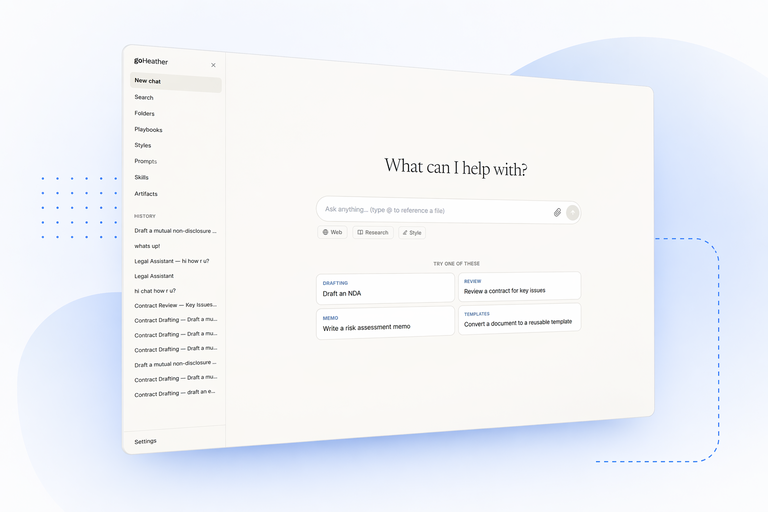
The New goHeather: In-app editor, surgical AI edits, edit from chat, and adjustable analysis levels.
Try For Free Now





Contract review has always been the classic bottleneck inside a growing company. Sales wants the MSA signed yesterday. Procurement needs the vendor NDA cleared before a pilot kicks off. Finance is waiting on an order form that has been sitting in a lawyer's inbox for six days. The work itself is essential, but most of it is repetitive, the same NDA, the same SaaS agreement, the same data processing addendum, week after week.
Over the last two years, a new generation of AI-powered contract review platforms has changed what that workload looks like. Large language models, paired with legal-specific training and playbooks, now handle the first pass in seconds instead of hours, flagging risk, suggesting redlines, summarising terms, and giving in-house counsel and contract managers the space to focus on the negotiations that actually matter.
If you run a legal or legal-ops function inside a company (not a law firm), the question is no longer whether to adopt AI contract review. It is which tool matches your volume, your budget, your security posture, and the way your team already works. This guide walks through the platforms worth putting on your shortlist in 2026, with a practical framework for choosing between them.
Modern platforms go well past "summarise this PDF." Expect most serious tools to cover:
Not every vendor does all of this well. The differences matter when you are trying to decide between a $99-per-seat tool and a six-figure CLM implementation.
Best for: In-house legal and legal-ops teams at small and mid-sized companies, plus sales and procurement teams that review the same contract types over and over.
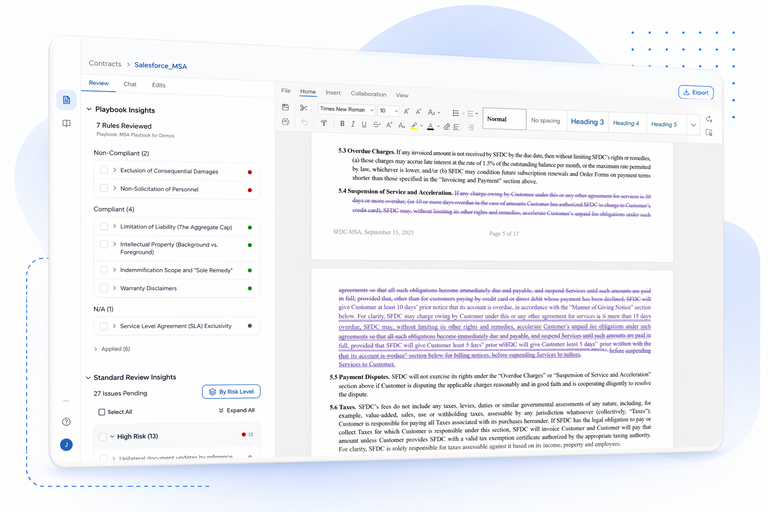
Highlights: Lawyer-trained AI purpose built contract workflows, native web app document editor or native Microsoft Word add-in, chat and make edits from chat, drag-and-drop PDF or DOCX review, prebuillt and DIY playbooks built from a template or manual entry, severtity filters, red-light/green-light approval workflows, drafting, editing, comparisons, prebuilt prompts, training documents, OCR for scanned documents, pricing from $99/month, which is the lowest priced contract review product in the indistry.
Why it stands out: goHeather was built to make serious contract review available to companies that have been priced out of enterprise platforms. You do not need a six-month implementation or a dedicated legal engineer. A legal-ops lead (or even a non-lawyer contract manager) can upload a preferred NDA, turn it into a playbook, and start reviewing counterpart paper the same afternoon. The red-light/green-light workflow is particularly useful for back-office teams — a junior contract analyst can clear standard NDAs and vendor agreements against a playbook, and escalate only the real exceptions to counsel.
Bottom line: If you are a growing company that wants fast, lawyer-tuned review without the cost and complexity of an enterprise CLM, goHeather is the cleanest fit. Try it instantly →
Best for: Corporate legal departments at larger companies that need depth, multilingual support, and integrated AI agents.
Highlights: 50+ pre-built playbooks, deep Microsoft Word add-in, cross-jurisdiction review (including International Playbooks across 23 countries), inline citations that link AI responses back to source passages, multi-document analysis across up to 20 files, and a new suite of five AI agents aimed at in-house productivity launched in early 2026.
Why it stands out: LegalOn has leaned hard into agentic workflows. Their Playbook Agent can turn existing templates into structured review playbooks without a human building the rules from scratch, and the company has been profiled by both the Financial Times and OpenAI for its work pushing contract review into a fully AI-augmented workflow.
Bottom line: LegalOn fits larger, globally active legal teams that already have template libraries and want AI that can reason across playbooks, templates, and matters in one system.
Best for: In-house teams that live in Microsoft Word and want AI redlining grounded in actual market data, not just a playbook.
Highlights: Word-native AI redlining, lawyer-built playbooks, clause benchmarking against market data, self-serve setup, Zero Data Retention with the underlying AI providers, AES-256 encryption, SOC 2/HIPAA posture, GDPR and CCPA support.
Why it stands out: Gavel Exec is currently one of the few Word-native tools that integrates real market data into clause analysis, which is useful when you want to know not just "does this deviate from our playbook" but "is this even close to market." It is a strong pick for teams pulling routine transactional work back in-house from outside counsel and trying to apply a consistent standard across everyone who touches a contract.
Bottom line: If your reviewers want AI that meets them in Word, respects your security posture, and tells them whether a counterpart's position is reasonable in the market, Gavel Exec is worth a demo.
Best for: Enterprises that want AI review embedded inside a full contract lifecycle management system.
Highlights: Playbook-based AI Assist for drafting and redlining, Ironclad Jurist — a 2026 release featuring autonomous AI agents that can draft, research, and negotiate specific clauses — and native CLM infrastructure for approvals, signature, repository, and renewals. Per Ironclad's own data, AI Assist can compress a 40-minute first-pass redline into roughly two minutes.
Why it stands out: Ironclad is a genuine CLM, not just a review layer. If the problem you are solving is "we have 10,000 contracts, no central repository, and no approval workflow," Ironclad addresses the whole system. The Jurist assistant brings generative AI directly into the .docx workspace legal teams already use.
Bottom line: Strong fit for mid-market and enterprise companies that need AI review and full lifecycle in one platform — expect an enterprise sales cycle and implementation.
Best for: Lean in-house legal teams at modern businesses that want AI review embedded inside a full contracting workflow — not bolted onto a separate tool.
Highlights: Agentic AI contract review that redlines third-party paper against your playbooks, surfaces risks and deviations, and proposes fallback positions with written reasoning; automatic extraction of key terms, clauses, and metadata into structured data; availability inside Juro, Slack, Microsoft Teams, and Microsoft Word so review happens where your team already works; and a full contract lifecycle platform underneath for drafting, negotiation, e-signature, and repository.
Why it stands out: Juro is designed from the ground up for business-led contracting, where sales, procurement, and finance need to self-serve while legal keeps control of standards. The review agent is built to let legal scale without becoming a bottleneck on every NDA and vendor agreement.
Bottom line: A strong pick for high-growth companies that want AI review and a full CLM in one platform, with the business-side self-serve experience most teams are actually trying to buy.
Best for: In-house teams focused on post-signature visibility, repository management, and making contract data accessible to non-legal stakeholders.
Highlights: AI extraction of key terms from legacy contracts, user-friendly dashboards aimed at finance, sales, and procurement as much as legal, reporting that non-technical users can actually operate, and a five-year run as a G2 category leader.
Why it stands out: LinkSquares is strong where a lot of pure review tools are weak: letting the business answer its own questions about existing contracts. If your GC is constantly getting pinged with "what's our termination right under the Acme MSA?" — LinkSquares gives the asker a place to go without interrupting legal.
Bottom line: Best as a repository and post-signature analytics layer, often deployed alongside a dedicated review tool.
Best for: Enterprise companies with large legacy contract estates, post-M&A consolidation needs, or deep ERP integration requirements.
Highlights: Machine-learning extraction across 50+ data points, strong handling of legacy contracts, native connectors into SAP and Oracle, and a platform built to ingest large historical volumes quickly.
Why it stands out: Evisort tends to shine when the challenge is not day-to-day NDA review but "we just acquired a company and need to understand what we now own, contractually." The ERP integrations also make it attractive for finance-adjacent use cases like revenue recognition and renewal forecasting.
Bottom line: A natural fit for Fortune 500-scale contract portfolios and post-M&A cleanups.
Best for: Enterprises that want an all-in-one CLM with a strong generative AI assistant layered on top.
Highlights: The "Leah" AI assistant for drafting and Q&A, GPT-powered drafting, pre-built integrations with Microsoft 365 and Salesforce, and full lifecycle management from intake to renewal.
Why it stands out: ContractPodAi has been early and aggressive on generative AI inside a CLM context. If your team is buying a CLM anyway and wants the AI assistant to be part of the same vendor relationship, it's a sensible shortlist entry.
Bottom line: Best for larger organisations that want review, drafting, and lifecycle in a single enterprise platform.
Best for: Multinationals handling cross-border contract portfolios, regulated industries, and teams doing serious diligence work.
Highlights: Anomaly detection engine, compliance mapping, multilingual support across dozens of languages, AI Q&A chatbot, and a strong visual analytics layer that makes reviewing a portfolio more like inspecting a dashboard than reading a pile of contracts.
Why it stands out: Luminance was one of the earliest AI contract review platforms and has kept its lead on visual pattern detection and multilingual review. If your team routinely touches contracts in French, German, Japanese, or Spanish, Luminance is hard to beat.
Bottom line: A strong pick for global companies and regulated industries where cross-border and multilingual coverage matter.
The shortlist above covers a wide range of price points and scopes. To narrow it, walk through these five questions with your legal, finance, and IT stakeholders.
1. Volume. How many contracts does your team touch in a typical month? Dozens point toward focused review tools like goHeather or Gavel Exec. Thousands — especially with a messy legacy estate — point toward Evisort, Ironclad, or ContractPodAi.
2. Review vs. lifecycle. Do you need help with the first-pass redline, or do you also need repository, approvals, e-signature, and renewal tracking? If it's just review and redline, a dedicated tool is faster and cheaper to deploy. If you're buying a CLM anyway, make sure its AI review capability is actually mature — some CLMs still bolt AI on loosely.
3. Where your team works. If your reviewers live in Microsoft Word, a native Word add-in (goHeather, LegalOn, Gavel Exec, Juro, Ironclad Jurist) will drive adoption far better than a browser tool that forces context switching. If your business stakeholders live in Slack or Teams instead, Juro's chat-surface integration is worth factoring in.
4. Security and compliance. In-house teams should ask every vendor the same questions: Where is our data stored? Is there zero data retention with your LLM providers? SOC 2 Type II? ISO 27001? EU data residency? GDPR and CCPA handling? How are audit trails exposed? These answers vary more than the marketing pages suggest.
5. Time-to-value and cost. Enterprise platforms often require a six-month implementation and custom taxonomy work before you see a redline. A tool like goHeather can be productive the same day for a fraction of the price. If speed of adoption matters, weight that heavily.
AI contract review is powerful, but it is not a substitute for a lawyer on anything that actually matters. A few cautions worth building into your rollout:
AI contract review is no longer a pilot — it is core infrastructure for in-house legal and legal-ops teams in 2026. The right platform for a 30-person company is not the same as the right platform for a 3,000-person one. Enterprises desiring contract CLMs will get the most out of platforms like Ironclad, Evisort, or ContractPodAi. Globally active teams will look at LegalOn and Luminance. Teams that want fast, affordable, lawyer-trained review that works inside Word on day one will find goHeather the simplest path from signed-up to productive.
Whatever you pick, the common thread is the same: stop paying people to read the same NDA a hundred times a year. Let your team spend its attention on the negotiations that actually move the business.
Try goHeather for free → goheather.io
Disclaimer: This article is based on publicly available information as of April 2026. The goHeather team did not manually test every product listed here. This content is for educational purposes only and is not legal advice. Readers should independently verify vendor claims and suitability for their specific circumstances. goHeather is a legal contracts AI, not a lawyer.
Jeff Dutton is a lawyer who advises on technology, corporate, privacy, commercial, employment and real estate law.
Jeff founded his own small law firm, Dutton Law, in 2016 (and merged it with a larger firm in 2019). Before that, Jeff was a prosecutor and a commercial law lawyer at a national boutique law firm.
Jeffrey is a frequent lecturer on legal matters and has been published in newspapers and trade journals. In addition, Jeff was the editor and co-author of a leading employment law text for lawyers for many years.
Education:
Western University, BA (2009)
University of Ottawa, Faculty of Law, JD (2012)
Get the latest contract tips, updates, and exclusive content straight to your inbox. Subscribe now and never miss out on what's new in contract law or at goHeather!
Our AI sifts through each clause, identifying potential risks. This enables us to provide quick yet comprehensive contract reviews, equipping you with the legal information you need to make informed decisions.
goHeather enables you to quickly create local employment contracts using lawyer-made templates. Our contracts include a free e-signature feature and provide access to a dashboard for managing all your employee contracts and key details.
USA
1 Sansome St., Suite 1400
San Francisco, CA 94104
United States
International
10 Dundas St. East, Suite 1002
Toronto, ON M5B 2G9
Canada